
Writing
A collection of my articles from travel magazines and my personal blog, sharing stories about our connection with nature.
Personal blog, Summer 2022
The Wild Heart of Oxford

The wind rustled the trees, and something moved in the forest.
A pair of orange eyes appeared through the leaves. A tiny Muntjac deer. We locked eyes, then he ran into the night.
These scenes played out in the Trap Grounds, a nature reserve in the heart of Oxford. It’s a wonderful place to get lost in, with vines twisting in every direction, forming archways above the paths. Its humble ten acres are bursting with life, home to hawks, foxes and water voles. But it wasn’t always this way.

The Story
To learn more about the Trap Grounds, I met with the secretary of the reserve, Catherine Robinson. She was standing on the boardwalk by the pond, watching a family of moorhens glide out of the reeds.
Catherine gave me a history lesson. In the 90’s this land was owned by Oxford City council, but it was neglected, covered with brambles and used as a rubbish dump. It was home to rough sleepers and drug users, containing little of the wildlife we see today.
In 1996 Catherine registered the reserve as a town green, reclaiming it for the local community. She hired volunteers to remove the rubbish and clear paths, making space to plant trees and create a pond. Then they let it grow. Over a few years the Trap Grounds transformed, from a trash heap to a paradise.

The Reality
Catherine looked concerned as we walked along the boardwalk, pointing out willow trees creeping above the reeds. She explained that the willows would suck the pond dry, reverting the bed to scrubland. “We’ve got to do something”, she said.
Though the Trap Grounds may seem like a natural sanctuary, it requires constant maintenance to keep it that way. Left unattended, the pond would dry up and the land would become covered in brambles – great cover for mammals and nesting birds – but inaccessible for humans.
Herein lies the challenge for British nature reserves: accommodating animals and humans equally. Because the reality is we are not selfless carers for wildlife; we want to experience it too. Those green trees and meadows are as much for our own happiness as for their inhabitants.
Humans always have an impact on wildlife, whether they intend to or not. Joggers and loose dogs send wild animals running, wasting their precious energy. For a nesting bird, or a mammal struggling for food through the winter months, this can be fatal.

Community
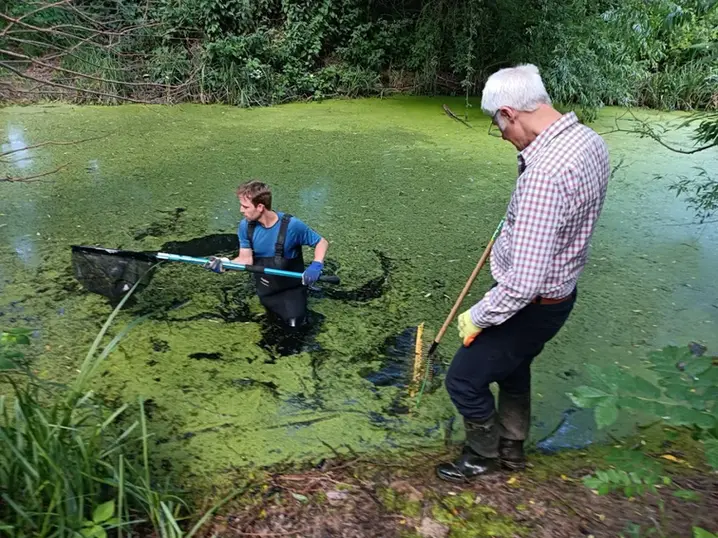
However, there is another side to the story. Over the years a group has formed around the Trap Grounds: like-minded people who value its beauty. There are students, families, and seniors, all volunteering together. Every Sunday we get our hands dirty, planting trees and daffodils, and building habitats for water voles. One day, we threw on waders and plunged into a pond, using nets to clear duckweed from its surface. When we were finished the water was so clear I could see my reflection. There was now space for dragonflies to breed, and I hoped to see them thrive in the years to come.
The Loss
The beauty of the Trap Grounds is bittersweet. It feels so alive and wild because our country has become so tame. Our nature is more degraded than 90% of nations, and since the Industrial Revolution the UK has lost about half of its biodiversity. When I was a kid, after a short drive our car windscreen was covered with insects. Not anymore.
The Remedy
One day, I woke up feeling depressed. The struggles of life were getting to me, and I knew I needed nature. So I went to the Trap Grounds. That morning the sky was clear, and the trees were an explosion of green. The air rang with the soothing coo of a wood pigeon, and the cheerful song of a chaffinch. I began to smile.
Despite the challenges facing nature today, the Trap Grounds is a triumph. In two decades, Catherine and her team have made a garden of eden from rubble. This gives me hope that nature can bounce back, if we give it a helping hand.
So if you find yourself in Oxford, visit the Trap Grounds. Take your headphones off and immerse yourself in the forest. Watch the reeds sway in the wind. In our modern world, I take comfort that there are still people who value life in its simplicity, who bathe in the forest just like me.

Photo Credits: Nicola Devine and Henry Small